Diet and economy
Primarily insectivorous, alongside domesticated, conditioned lichen that also double as their primary power source, driving mineralized mycelial blades to extract geothermal heat as a photosynthesis replacement like living semiconductors, no wells needed, with mineral ores and bitumen/volcanic soils as all four food groups; diet deeply tied to geological environment.Primary food sources: high-mineral, low lifespan, and high-protein subterranean insects — crystalline/metallic larvae, grubs, centipedes, and only those who are already in the process of natural death.Mineral-based feed: Kh'tuk farm specialized insects and allow fungal colonies to grow on prepared livestock in order to maintain biological stability, which requires rare metals: gallium, tungsten, copper, magnesium, cobalt, nickel, molybdenum, silver, titanium, and can be supplemented or seasoned with unique, sterilized soils near lava/magma or Shilajit-like deposits.Economy/industry centred on extraction and processing of deep-earth materials within their cities.Active mining operations: Kh'tuk are industrious miners extracting shimmering ores.Logistics: workers haul large ore boulders into durable silken bags within central hubs connected to all households for processing.Environmental cooling: physiology so tied to mineral intake that they use trace elemental gallium as a biological coolant, expelled through hair follicles during intense labor.
Language and recreation
Za'yitik — Spectrum of Thought (primary linguistic framework) Dual-layered language existing in both visual and auditory realms.Visual component (Spectral Lines): uses coloured, vertical lines, (usually written on obsidian or silk sheets, or printed into faceted glass prisms) with every word contained in its own symbolic "photon" as simple oval "packets", every hue its own sound/letter and a sentence ending in a free grey line symbolizing a curtain of lead blocking the light.It is painted with crystalline, metallic paints or cryogenically frozen and ionized residues, that shift easily across the listener's vision and contain high information density; sequences function and appear similar to barcodes or atomic spectrograms, transmitting complex technical/emotional data at high speeds.While the Arachmen cannot see in colour or sense non-metallic chemicals like pheromones (they see in monochrome only) and possess a much wider, blurred line of sight, they can still tell the difference between the colours through feeling the structural differences in the light refraction and smelling the metallic compounds that give them their pigments that are seen by the human eye.Verbal component (Acoustic Vibration): a mechanical symphony; produced through abdominal buzzing (inflating, deflating and compression of hollow chitinous chambers in the thoracoabdomen) and fang stridulation (rubbing cheliceral setae together in a velcro-like function) to create precise high-frequency clicks and hisses that travel through air for very long distances; pitch altered by the chambers and inner echoing/ reverberative boosts created from it's specialized tongue, which is covered in sensitive, resonant, relay dish-shaped cilia that catches frequencies like a radio, and guides it into highly focused, precise directions, as well as catch/absorb resonance to create sonar-like echoing that they use for environmental awareness.While they lost the ability to sense vibrations, drum on the ground or silk, and use pheromones to communicate due to human genetics, they still retained the stridulatory organs some arachnids use to audibly hiss and warn predators, adopting it as their main form of communication and combining it with dolphin-like sonar.Their setae also grew eardrum-like structures that gave them a highly redundant, pinpoint auditory system that allows for building a complex map of surroundings from air-based echoing much better then most mammals.Hex-Sign — "The Geometry of Motion" (rapid sign language) Used where silence is mandatory or speed is essential.Geometric precision: uses all six arms to form complex interlocking geometric shapes; each shape combination represents a concept based on how the shapes "interlock" smoothly, evenly, or patterned.Stealth & night-cycle: primary mode of communication during their quiet night hours; keeps the colony coordinated without the heat generation or sleep disruption of verbal filing.
Childcare and pets
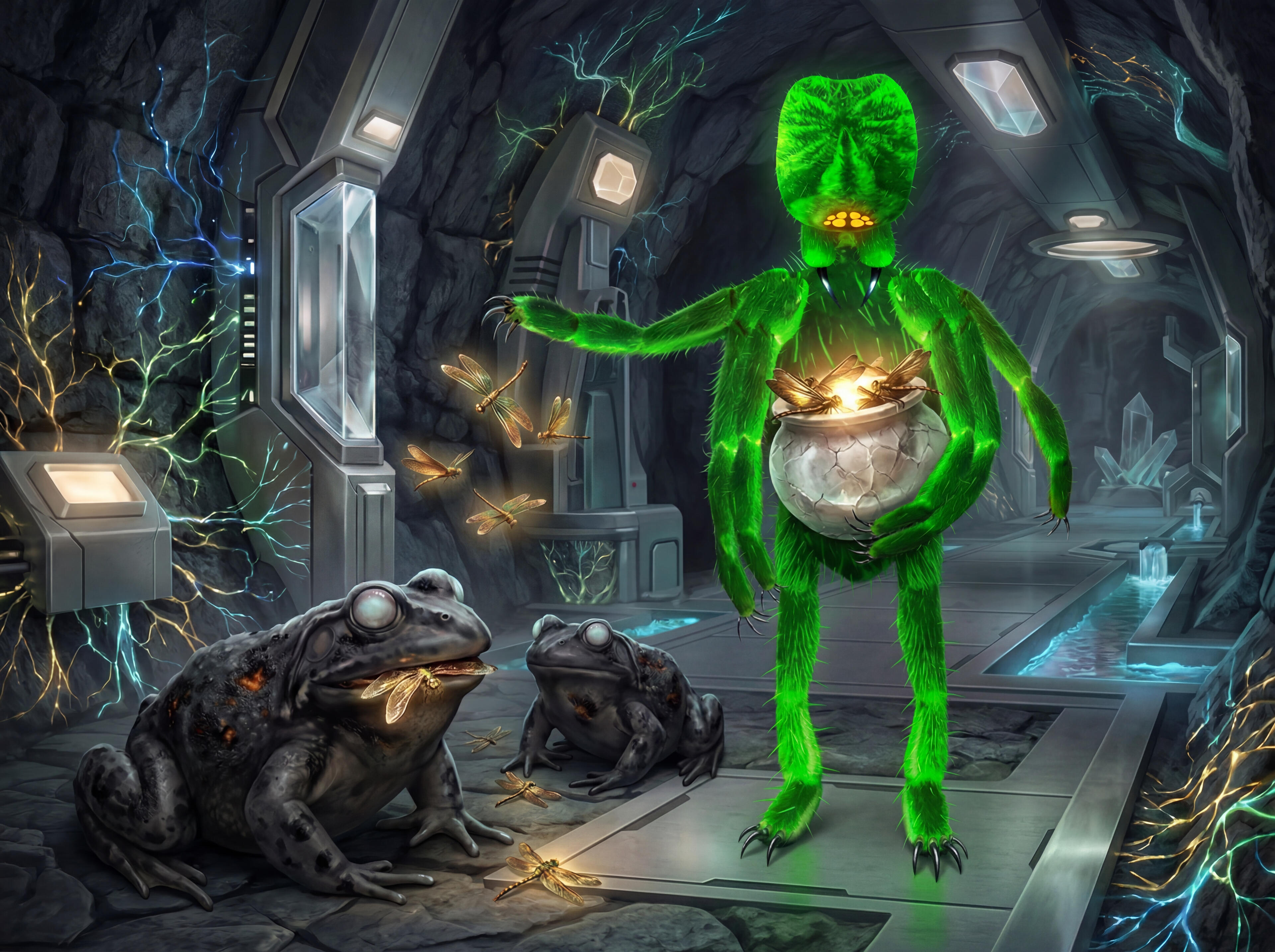
Communal hatcheries: egg sacs placed in specialized polymer incubators, two to five hatchlings per sac.Older young raised in mineral-controlled nurseries, fed via automated dispensers to ensure proper exoskeleton hardening.The Ce'puq (primary pet and tool): a dog-sized, environmentally altered frog that sees in infrared and detects the tiniest chemical changes in the air; jet black, milky-eyed.Used for heavy excavation via powerful legs.Used as living thermometers to detect dangerous lava or fire heat that can incapacitate or rapidly dehydrate the Arachmen from a dozen meters away; the Ce'puq are naturally immune to it due to skin that is composed of a naturally occurring but complex composite of keratin, cellulose, graphite, and fullerenes (buckyballs) arranged in an interchanging structure akin to a QR code or labyrinth, trapping phonons with near perfect efficiency, as pre-stored, dedicated, and pressurized reserves of mixed, long chain hydrocarbon-like wax and water overtop of the fat layer evaporate.Also used as family pets and for juvenile play and protection.
Computation
Data Balloons: Ultra-thin chitosan membranes form air-filled sacs embedded with magnetic nanoparticles in their walls.Magnets concentrate paramagnetic oxygen and, via targeted UV-driven localized micro-ionization, sustain stable electromagnetic vortex patterns and charge domains in the contained air.Encoding: negative oxygen ion regions read as zeros; positive oxygen alignments as ones.Vortex chirality (clockwise/counterclockwise) in neutral particle regions adds high-density encoding dimensions.
Fluorescent nano-crystals attached to the magnets permanently record these states under UV exposure for archival storage.Balloons self-assemble into genome-shaped 3D arrays where inter-balloon magnetic and field interactions enable collective, parallel computation suited for text, software, simulations, and interactive strategy games.
Equipment and defence
Ehl'khn ("Liquid Quartz") Composition: a quasicrystalline, high-entropy alloy and metallic glass hybrid invented by the Kh'tuk.Grown on a silken base over several months, with mycelial networks guiding its growth; mycelium then burnt away, leaving behind highly ordered Ehl'khn on a silk backing.Production: tiny amounts of coltan (black version) wolframite (grey version) or moissanite (white version) are stretched, compressed, heated, and frozen repeatedly as filling into page-like, isolated crystals and hollow plates of tridymite or crystalline boron that are self contained within each other repeatedly in a fractal-pattern, like swords in sheaths, micron by micron in ultra fine grains by the mycelium onto the scaffold in a highly loose, spaced-out fashion of both tetrahedral and octagonal patterns in a banded fashion of highly chaotic and interchanging, but in some subsequent areas still highly ordered, lattice that changes it's geometry logarithmically, and is finally stabilized under deep, pressurized oceanic and aquatic environments — saving weight and reducing permanent deformation through the high entropy quasicrystalline/interchanging face-centred cubic structure.Empty spaces are ribbed with folded filaments of magnesium and filled with divergently formulated indium-tin-gallium (Galinstan) alloys mixed with dense mucins from the Ce'puq tadpoles, like concrete rebar.Properties: flexible like rubber due to fine grained, loose structure and liquid filling, and harder than quartz on the surface, opaque crystal appearance, double functions as sound insulation.Cone-Snapper: A tapered, throwable ordnance weapon shaped like a traffic cone.Composed of several high-tension silk ribbons cross-linked with insect resilin decreasing in percentage toward the tip, spiralling around a four segmented, core ring of clay that closes in upon release, is lined inward with needles of cementite. and ends in a sharp, moissanite tipped pin.Stretched and thrown from its wide base like a high-tension sling, traveling through the air as a unified, static projectile with its potential energy stored securely inside alternating elastic resilin and dampening silica bands.Upon impact, the abrupt deceleration of the heavy base triggers a kinetic deformation wave that surges forward toward the apex.As the wave travels down the tapering ribbon—where decreasing percentages of resilin and increasing levels of added silica are sealed into the silk with Ce'puq oils—it compresses into an exponentially tighter cross-section, accelerating the mechanical energy wave to high velocity right as it penetrates the target.This snap drives the sharp, hollow pin at the apex deep into the target armour to anchor it. The remaining forward kinetic momentum causes the trailing double-ribbon structure to violently flip inside out, wrapping tightly around the target like a high-pressure tourniquet as the previous ribbons from the other side tangle wildly and create highly tensioned knots.This one-second delay is entirely mechanical, marking the time required for the contracting silk net and clay ring/pin to maximize its constriction and seal the weapon flush against the hull. As the wrapping ribbons reach peak constriction, they exert an immense, crushing downward hydraulic pressure back toward the centre of the cone.Once this pressure crosses its critical threshold, it shatters an internal filling of highly reactive caesium or iron-lithium alloy housed inside the clay ring, triggering a sub-millisecond, 360° inward expulsion that collapses inward from all sides.The rigid, parabolic geometry of the collapsed cone directs the resulting 2500 °C jet into the target from all sides and cycles inward, focusing into the pin, creating a focused, hyper-velocity directional plasma jet (the Munroe Effect) that blows and sears through high-entropy armour lattices while the silk net tugs inward and implodes alongside it mechanically for demolition, mining operations, extreme armour penetration, and localized area denial.Beryl Projectile System: Beryl, fluorite, or in rare cases moissanite crystals are grown in a deadly cocktail of hydrochloric acid and azide salts.When broken into shards, they are coated in magnetite at the base; magnetically latch onto the claws when in close proximity for ease of reloading across waist belts.In the Kh'ona's case: multiple acid-bathed beryl shards are always replaced by massive, single-shot diamonds or purified boron for pure kinetic force and compatibility with their lack of multiple claws — they use their pincers (chelae) instead of multiple claws like the Kh'tuk.Ballistic Pulleys: A silk bicycle-pulley-like system attached to the back, for both Kh'ona and Kh'tuk.Stretching the neck and arms rapidly will activate the pulley to spin and eventually cock the crystals (or diamonds) at high tension through chitinous ropes wrapped around the tarsus.Flicking the arm quickly flips another magnet, facing the north poles of the other magnets, and launches the projectile in a straight path with the built-up pressure combined with the magnetic pole repelling.With the Kh'tuk rapid-fire design, crystals launch at up to 1200 metres per second each and eight to nine crystals per second, carrying a high-calibre rifle round worth of energy each. Silk pads placed beneath the pulley and the six arms to absorb launch recoil.Suffocation Parachutes: Kh'tuk-made, CO2-filled, oxygen-absorbing bag of silk, worn on the upper back.Thrown over multiple enemies; equipped with microscopic, hollowed hooks of sodium polyacrylate; tightened with six elastic pull-strings to squeeze together and suffocate targets with pressurized CO2 near instantaneously.The bag purposely tears and crushes while the polyacrylate dehydrates the target upon contact and optionally injects cyanocobaltate.The Hypostome-Wedge (The Breach Tool) A brutal, Xa'sef-forged hydraulic-driven chain ending in four hooks forged from scavenged chromium salvaged from Arachmen mining infrastructure.Reverse-curved, serrated barbs on each hook mimic a tick's hypostome; once slammed into an Arachmen's joint, a manual crank-ratchet, designed to be pulled from multiple individuals at once, with a grip-enhancing structure, locks the barbs into a death-grip, pinning the target and neutralizing mobility.Hydraulic collapse mechanism: an attachable internal wedge between all four hooks can act as a high-pressure piston; on activation it injects a concentrated burst of pressurized mercury into the target's armour seams.Uses a two-stage pneumatic-to-hydraulic intensifier: a nitrogen gas-expansion chamber drives a large primary piston that forces mercury through a narrow-bore secondary cylinder, leveraging Pascal's Law to concentrate pressure into a high-velocity spike capable of shattering an Ehl'khn lattice with enough time and team effort.This force, combined with the mechanical leverage of the barbs, exploits the Ehl'khn crystalline structure and the Arachmen's natural segmentation to shatter plates — forcing immediate, localized structural collapse of armour, target, and infrastructure.The Reactive Sodium-Core Shield (The Suppression System) Another Xa'sef-made weapon; a heavy, hourglass-shaped tower shield made of nickel or oxidized iron providing both kinetic defence and sensory sabotage.Core packed with pure, reactive sodium metal plus an internal angled packet filled with thick carbon-black made from burnt fungal matter.When struck by a hydrochloric-acid-bathed crystal or heavy impact, the outer nickel plating sacrifices itself while thermal stress forces the sodium core to rupture and neutralize the acidic ammunition.The resulting sodium explosion triggers a violent and blinding back-blast of chemical energy, simultaneously venting a massive cloud of carbon-black fog.This instantly blots out the cave's light, coating the Xa'sef and surroundings in the viscous substance and leaving them much less visually and tactilely distinguishable while being slightly less audible, while they execute their counter-ambush.Claw Casings: Segmented sheaths forged from the Kh'ona out of high-density hardened molybdenum, sliding over the natural chitinous and iron-tungstate enriched claws of the Kh'tuk and Kh'ona.Within a proximal shoulder housing, a series of silken-spring recoil buffers are interlinked with the sheaths and weighted bismuth runners.When a strike is initiated, rapid forward acceleration causes the runners to slide forward, shifting the limb's centre of mass toward the tip to create a "whip-snap" momentum effect.This inertia-driven design dramatically amplifies the kinetic energy of every blow, turning a natural claw strike into a high-pressure impact capable of shattering entire boulders of ore — outperforming a human pickaxe by several orders of magnitude.The internal silken-spring assembly acts as a mechanical shock-absorber, isolating the Arachmen's hard, brittle natural limbs from the bone-jarring vibration of the strike.
Ceremonies
The Debugger Fungi: Function and Effects: a powerful hallucinogenic fungus; inhalation of spores introduces chemicals that overstimulate the pattern-recognition centres in the synganglion, producing immensely exaggerated visual distortions.Distortions exaggerate only polygonal shapes, turning rough surfaces, spheres, or irregular forms into highly ordered triangles, squares, and hexagons that spawn smaller repeating versions.Also used as insect feed in dried, deactivated form, due to its concentrated protein content.
Psychological interpretation: users believe the hallucination lets them perceive the hidden geometric and genetic "code" of life — the very geometric shapes perceived."Debugger" designation: stems from the belief that those with deep knowledge of the Supreme Compiler's code can use the fungus-induced state to speak in a universal language, theorized to subtly manifest balance within the universe and even alter genetics themselves — debugging the program of the universe.Societal Regulation and Use: Usage strictly regulated, restricted to four groups: newly married couples; those in pre-moult; those chosen by census data to become temporary governors; individuals transitioning into priesthood.Testing protocol: during exposure, users are monitored to determine their psychological reaction.Positive outcome: profound peace from alignment with the Compiler.
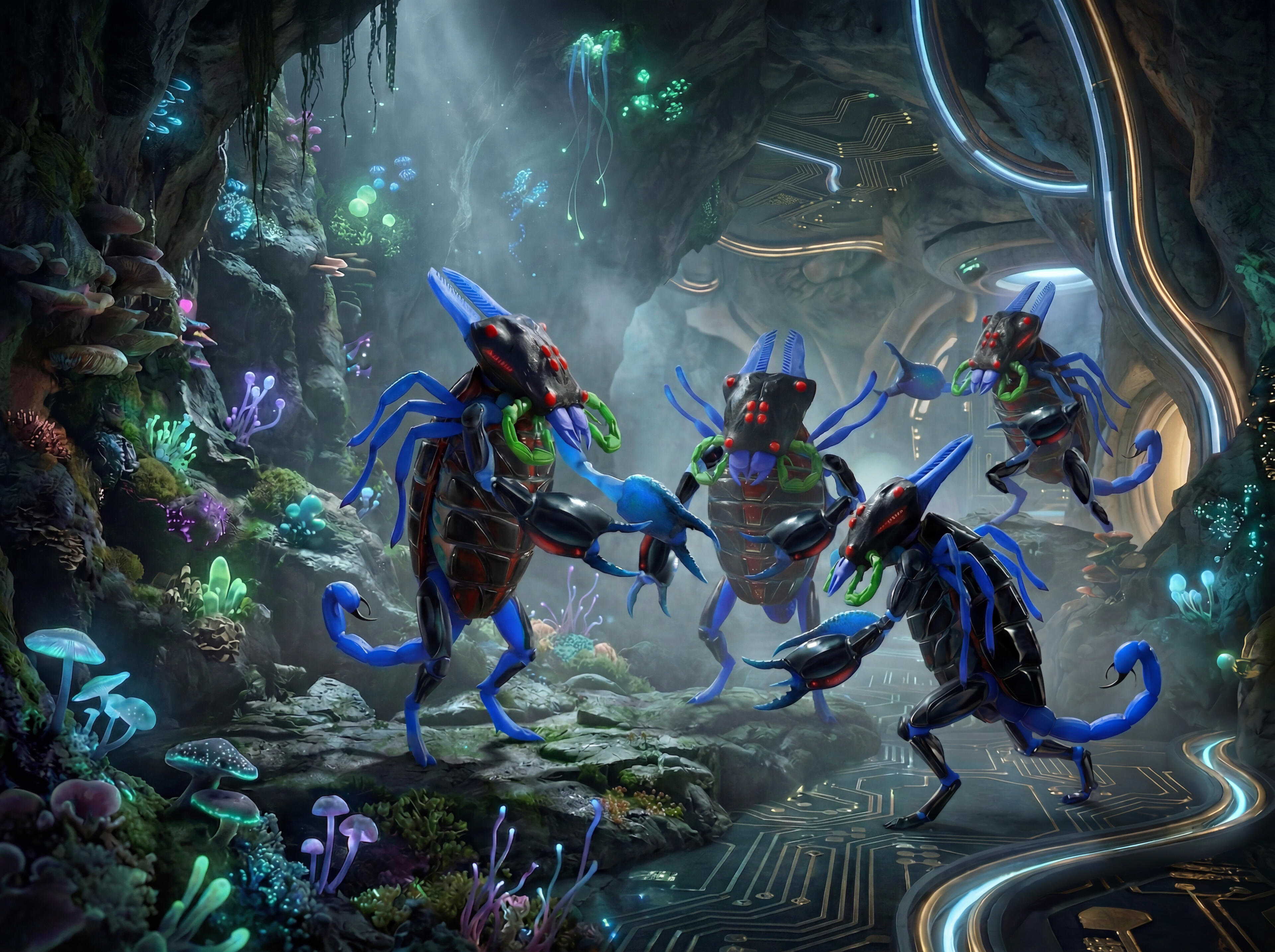
Negative outcome: psychological torment, fear, and long-term anxiety that may imprint upon one's own bloodline. Inter-Species PerspectivesKh'tuk: maintain strict regulatory control of the live form and spores; view it as a sacred tool for communion with the Compiler.Kh'ona: view the fungus strictly as illicit; advocate banning it as spores or live forms, using its processed, sterilized form instead as a protective agent against cancerous free radicals and other fungal infections. To them, being near decomposing, unsterilized fungus for long periods (as the Kh'tuk use it) can create rapid tumour growth and fungal outbreaks across the brain and eventually the whole body, sometimes even creating homicidal tendencies.Xa'sef: actively seek out/destroy entire colonies of the fungus as an act of defiance against the Compiler's laws.Their biology is immune to all its effects due to anti-fungal vanadium compounds secreted in their blood, evolved to resist it after the Kh'tuk historically used it as a weapon against them (it once caused the same effects in the Xa'sef as in the Kh'ona).Ce'xata (Archiving the Mortal Runtime) The Arachmen's dual-brain structure — a high-frequency, high flicker-fusion rate (120 Hz) synganglion weaving in and out of a mammalian cortex, going up to 1200 Hz critical flicker-fusion rate under the most extreme stress — is so energy-intensive that it runs on a ruthless "garbage collection" protocol.After every 28–33 years (human time), the Kh'tuk and Kh'ona brain initiates a mandatory neurological purge, overwriting all episodic memories, traumas, events, and personal relationships to maintain their immense processing speed — keeping only basic social skills and vocabulary needed for survival and reproduction.To combat this erasure, the society constructs Ce'xata — vast subterranean chambers originally conceptualized and invented by the Kh'ona — where the struggle to maintain identity is turned into a sacred duty.Every Chl'kezha, the populace of Kh'tuk and Kh'ona gathers here to stave off the void.They perform intricate geometric dances and engage in geometric, lyrical combat using complex, high-speed 3D sign language, signing at such velocity that the shapes blur into a continuous flow of geometric poetry, to harmonize their neural states and defend the significance of their personal timelines before they are lost to synaptic drift.During these ceremonies, citizens transcribe their most profound experiences — especially happy moments with family or environment, personal feelings, and relationships — onto obsidian totems using cryogenically locked, ionized paints, alongside murals of sacred animals, waterfowl, and symbolic imagery of their society's history.The waterfowl as messengers carrying their memories to the rest of the cosmos, and as symbols of individuals cooperating toward a shared goal despite their differences, in perfect, geometric synchronization, (their V-shape) mirroring the sacred act of compiling.Once applied, the paints used undergo a thermal-crystallization process, permanently hardening onto jagged monoliths that stand as physical externalizations of their fading souls.These monoliths are then placed in modified data balloons and installed beside the city's rhythmic time wires, physically tethering the individual's ephemeral history to the literal heartbeat of the cavern.The ceremony culminates in a Ce'vhlkeh-long collective meditation; as the Arachmen sit in the presence of their crystallizing memories, they do not merely "remember" their lives — they perform a solemn handover of their identity to the collective.By anchoring their personal narratives into the city's architecture, they ensure that even when their biological memories are wiped, their contributions to the Compiler's grand design remain — preserving their sense of belonging in a world where an individual's past is never truly permanent, moving past their animal instincts and evolutionary limits, while simultaneously paying respect to the Compiler for doing so.SPORTS — Ka'vahl (The Compiling Orbit) The arena: a massive sunken hexagonal stone pit with vertical, porous walls of limestone or decorative calcite.The ball: a heavy solid osmium sphere, or a hollowed-out Ce'puq bone filled with gravel to make its flight path heavy and unpredictable.The rules: two teams of four Kh'ona athletes compete to keep the heavy ball in a continuous, uninterrupted orbit along the arena walls using only their six arms, two chelae, stingers, and sometimes equipped titanium poles as tail attachments. Touching the ground with the ball is a "syntax error" (loss of points).The martial edge: the ball can move at lethal velocities, up to 30 kilometres an hour, and a weight up to 60 kilograms. Players use strong legs or titanium tail-attachments to spring off the stone walls, catching and redirecting the heavy sphere mid-air.An extreme test of low-center stability; naturally trains players to calculate trajectories and momentum on the fly, directly translating to their mastery of the single-shot diamond crossbow on the battlefield. Martial arts:The way of The Gallium Ghost: Designed to systematically dismantle an opponent without delivering a single traditional strike.
Named after gallium infiltration — the real-world phenomenon where liquid gallium seeps into solid aluminum, destroying its grain boundaries and causing the metal to crumble like wet chalk.Also based on the close-quarters multi-limbed combat behaviour of scorpions and on bees' ability to cook hornets with their own collective body heat.Erasing Distance: the Kh'ona uses a secondary titanium tripod as a tail attachment, with two thin, heavily segmented and elongated springs around a central, hooked stilt to their telson, bolted into a sand-weighted, Kh'tuk-made apron around the waist to increase lower-body centre of gravity — allowing them to slide directly into the opponent's personal space, nullifying the reach of heavy weapons or insurgent clamps once gripped on, keeping their legs unstable and completely still with the added weight and enhanced support.Parasitic Latching: using all ten limbs, they adhere tightly to the opponent's joints like a pursuing scorpion turned viscous liquid, tracking every micro-movement of the enemy's muscles while intensely vibrating, bear-hugging, and shaking the enemy at high speed to generate burning heat (as a bee does to a hornet).Kinetic Redirection: when the enemy struggles or strikes, the Kh'ona does not block — they fluidly guide the blow into empty space or force the enemy's own limbs to collide with each other.The Disintegration: while deflecting attacks, the Kh'ona drops their massive weighted lower body even further to apply slow, agonizing hydraulic downward pressure.THE MARRIAGE SYSTEM — "Interface Merge" In a society where every individual cycles through every job to maximize collective skills, marriage is the ultimate long-term collaborative project — a highly calculated, consensus-backed partnership designed to balance the community's genetics and cognitive bandwidth.The Compatibility Scan: data balloons track citizens' lifelong skill progression, physical endurance, and neurological patterns. When two individuals demonstrate complementary skill matrices (e.g., a Kh'tuk master of organic data processing paired with a Kh'tuk master of kinetic physics), the system flags them as an optimal Interface.The Debugger Initiation: before the union is finalized, the couple enters a mandatory pre-moult isolation period, consuming small, diluted amounts of the hallucinogenic Debugger Fungi together. They must navigate the intense shared geometric hallucinations during the city's monthly recreational dance ceremonies.Positive outcome: achieving a mutual state of profound peace proves their mental frequencies are perfectly aligned to co-raise young.
Negative outcome: if one experiences torment or panic, the interface is flagged "unstable" and the union is aborted by the priests, showing no mental connection between the two.The Hatchery Contract: once married, they do not live in isolation; granted a communal domestic unit and allowed to deposit genetic material into the Communal Hatcheries, where their egg sacs are placed into specialized polymer incubators.
Judicial systems and views on life/death
The Remediation Phases (The Punishments) No prisons (seen as a stagnant, wasteful use of space mimicking the old Empress's hive-like regime). Instead, a tiered correction system:Phase 1 — Code Optimization (Forced Labor & Mentorship): for minor deviance (slacking heavily during the crucial farming and mining cycles, or disruptive/sabotaging communication), the individual is stripped of all administrative titles and placed under direct 19-hour supervision of a Kh'ona martial arts instructor; put into physically demanding labor or strict strength-training sectors during that short time, e.g (hauling raw ore boulders) to burn off erratic neural energy and relearn bodily discipline.Phase 2 — System De-Fragging (The Fungi Vaults): for severe crimes (physical assault, illegal political factionalism), the criminal is locked inside dark, hollow iron chambers filled with a high concentration of Debugger Fungi spores, forced into a prolonged hallucinogenic state bombarded by repeating triangles, squares, and hexagons. The goal is to violently strip away their chaotic ego and force their mind to re-align with the universal geometric code.Phase 3 — Total Deletion (Exile): if an individual undergoes deep-fungi treatment and their mind completely breaks — or if proven to have committed homicide — they are declared a Fatal Exception.They are stripped of their belongings, their claw casings and accumulated tantalum are removed, they are sedated, and physically expelled from the subterranean cities into the deep, unmapped volcanic wastes where the Xa'sef roam — forever, never allowed to return and with little awareness of whereabouts.The Software Transition: Death is viewed as "Garbage Collection" — a system trimming of old, heavy code to allocate resources for optimized new generations.The Dual-Universe Model: reality has two parallel planes — the Active Runtime (our world, constantly updated and ordered) and the Negative Universe (the "trash bin" database where uncompiled legacy errors and bugs separate into other forms and spawn chaotic, formless horrors).The Mourning Patch: mourners do not grieve for rest; through high-speed Hex-sign choreography and Za'yitik acoustic buzzing they actively program the departing soul. They pray the deceased will become blessed by the Compiler and act as a "system patch" to inject geometric order and debug the chaotic Otherworld.BURYING: Corpses buried in pentagonal sarcophagi in sorted underground yards.At birth, every citizen is assigned a unique algorithmic sequence of shapes as a nickname for enhanced identification in their data centres.
Upon death, these shape-names dictate the exact physical coordinates of their sarcophagus relative to others, locking the graves together into massive three-dimensional cooperative structures that mirror their architectural blueprints.
Economy and education
THE TWO-TIERED ECONOMY — Copper & Tantalum PentoxideCopper (The Survival Base)Universal distribution: distributed automatically to all citizens in equal amounts regardless of demonstrated contribution, guaranteeing basic sustenance and hydration until it re-circulates to unacceptable levels and is melted back down by the cities chosen manager.The Mining Dependency: tied directly to the health of the mining sector. If miners collectively slack, the community suffers severe copper deficiency, causing immediate physical and mental pathology (low blood pressure, eventual exoskeleton decay, cognitive fatigue) which helps to motivate them.Tantalum Pentoxide (The Freedom Token) Material distinction: pure tantalum is strictly structural or decorative; only tantalum pentoxide (the white, oxidized form) is legally recognized as freedom tokens.
Systemic purpose: isn't used to buy more survival necessities; instead spent to "buy back" into preferred jobs, earn jewelry, artistic materials, travel, sabbaticals, independent research, decoration, and hobby equipment.The Skill Mastery Scale (exponential payout for multi-disciplinary mastery):Base Entry (1 skill): 1 disc per cycle. During early occupational development, individuals undergo a mandatory set of broad rotational service across essential disciplines, allowing both the individual and the civic algorithms to identify emerging aptitudes while ensuring every citizen develops a diverse practical foundation.Balanced Skill Match (2 skills): 2 discs per cycle if two assigned jobs are performed with equally high capability.Advanced Scale (4 skills): 4 discs per cycle upon mastering four distinct trades.Super-Advanced Scale (5 skills): 10 discs per cycle, granting a surplus of career choice and time off.The numbers can go to infinity.Mastery Reaffirmation: Mastery is not permanent. Every discipline must be periodically reaffirmed through continued practice and demonstrated proficiency.If competency declines through disuse or deteriorating performance, that mastery enters a dormant state until it is renewed.Freedom Token allocations are calculated from an individual's currently active masteries rather than their historical achievements.GENERATIONAL GARBAGE COLLECTION — The Wealth Wipe: To prevent permanent aristocracies or hoarded generational wealth, at the completion of the Ninety-Third year of employment, every citizen returns their accumulated Freedom Discs to the Foundries as an offering to future generations.Resource recycling: collected discs are melted down and re-assigned to the incoming generation of young hatchlings from birth, keeping the financial system perfectly balanced.External Trade Restrictions: To preserve civic self-sufficiency, adaptive mastery, and resilience against external economic dependence, the importation of foreign goods and services is strictly prohibited.Every city is expected to satisfy its own essential material and occupational needs through its internal civic lattice.Exceptions are granted only for experimental technologies, scientific specimens, archaeological artifacts, or other materials acquired exclusively for research, analysis, and the expansion of collective knowledge rather than commercial consumption.CIVIC ORGANIZATION (The Living Non-Profit)The Arachmen recognize no distinction between government, economy, or community.Every city functions as a single decentralized civic institution whose purpose is the continual cultivation of knowledge, mastery, and collective well-being rather than the accumulation of profit.No corporations, shareholders, or permanently owned industries exist; instead, every household serves as an independent productive node within the greater civic lattice, contributing labor, research, manufacturing, agriculture, maintenance, and mentorship directly into the city's shared infrastructure.Unlike human settlements that isolate residential districts from industrial centres, every household is physically integrated into one or more workplaces and households through interconnected silk-lined tunnels, hydraulically driven elevator pods, and corridors.Workshops, hatcheries, foundries, laboratories, fungal farms, clinics, and archives are all evenly distributed throughout the city itself, allowing knowledge, materials, and labor to circulate naturally between neighbouring households. Work is therefore not a destination, but an extension of daily life, with children growing up surrounded by active production and continual intergenerational mentorship.Occupational distribution is coordinated through the Civic Coordination System, which continuously evaluates infrastructure, resource demand, environmental conditions, individual mastery profiles, and community preferences to recommend adaptive work rotations.Citizens are encouraged to cultivate broad, interdisciplinary competence throughout their lives, with workplaces existing to develop mastery as much as to produce goods.No citizen permanently belongs to a profession, nor does any workplace permanently belong to an individual.Rather than "electing" politicians, an entire household is chosen as a civic governor, and selected for a single rotational cycle through a combination of algorithmic, analytical recommendation and finalized community consensus.Not voting, but detailed comparisons and data of what is needed most for the communities long-term wellbeing and the chosen one's level of religious connection and belief.Candidates are identified according to demonstrated mastery across multiple disciplines, historical reliability, mentorship, problem-solving ability, and their capacity to coordinate complex systems. Following public confirmation, the selected governor serves only as a temporary coordinator responsible for synchronizing the city's existing institutions before returning to ordinary occupational life.Leadership is regarded as a temporary civic responsibility rather than a permanent position of authority, ensuring that governance remains adaptive, decentralized, and inseparable from the continual cycle of Compilation and Decompilation.EDUCATION SYSTEM (Kh'tuk & Kh'ona) Natural evolution of their occupational rotation system; fits their anti-hive philosophy.Sitting children at desks to fill static forms or write essays is seen as a waste of cognitive potential — a rigid, artificial method mirroring the old Empress's stagnant regime.Education is entirely decentralized, kinesthetic, and integrated into the colony's daily survival. The "Work-Guild" AcademyNo separate, isolated school building exists; the entire civilization functions as a living campus.The Practical Learning Loop: From birth, young Hatchlings (Ages 0–2): and Growing Juveniles/Adolescents (Ages 5–8): monitor data balloons under Masters, feed Ce'puq, farm, and sort out valuable gems from mixed rock to aid miners in real time.Adult transition: apprentice in defence/full-scale mining. From the moment hatchlings emerge from mineral-controlled incubators and undergo initial automated exoskeleton hardening, they are paired with adult mentors across sectors, learning by doing real, impactful work tailored to their developing physical capabilities.Geological Math: instead of abstract arithmetic worksheets, a young Kh'tuk learns geometry and weights by physically sorting mined ores into pure bins, calculating the structural balance needed to pack a silken haul-bag without tearing it.Kinesthetic Physics: a young Kh'ona doesn't read about velocity or trajectories — they are placed in the Ka'vahl pits with hollow tin training spheres, learning to angle their bodies and use hooked tail-attachments to absorb impact forces in real time.Mentorship Over Monolithic Classrooms:Because every adult experiences numerous occupations throughout life, continually expanding and reaffirming a diverse network of practical competencies, every adult is a qualified teacher.No specialized, separate class of "schoolteachers"; an adult working in the insect agricultural farms that year is automatically responsible for guiding the children assigned to that sector.Creates deep cross-generational bonds; children don't just socialize with same-age peers but grow up in constant, meaningful dialogue with adults, learning social cooperation, historical context, and technical mastery directly on the factory floor or in the hatchery.The true test of a youth's education occurs during their pre-moult phase.Instead of a sit-down exam, psychological and physical readiness is assessed by community mentors.If they have cultivated the necessary resilience and a diverse, complimentary skill set, they are granted their first exposure to the Debugger Fungi.Achieving a positive compile during this sacred ceremony serves as official graduation into the adult occupational matrix, proving they are ready for the continuous, lifelong cycle of leadership, defence, and labor for the collective good of the alliance.Constitutional Principle: Life exists to compile understanding and decompile ignorance.
Theology of "Compilism" and "Decompilism"
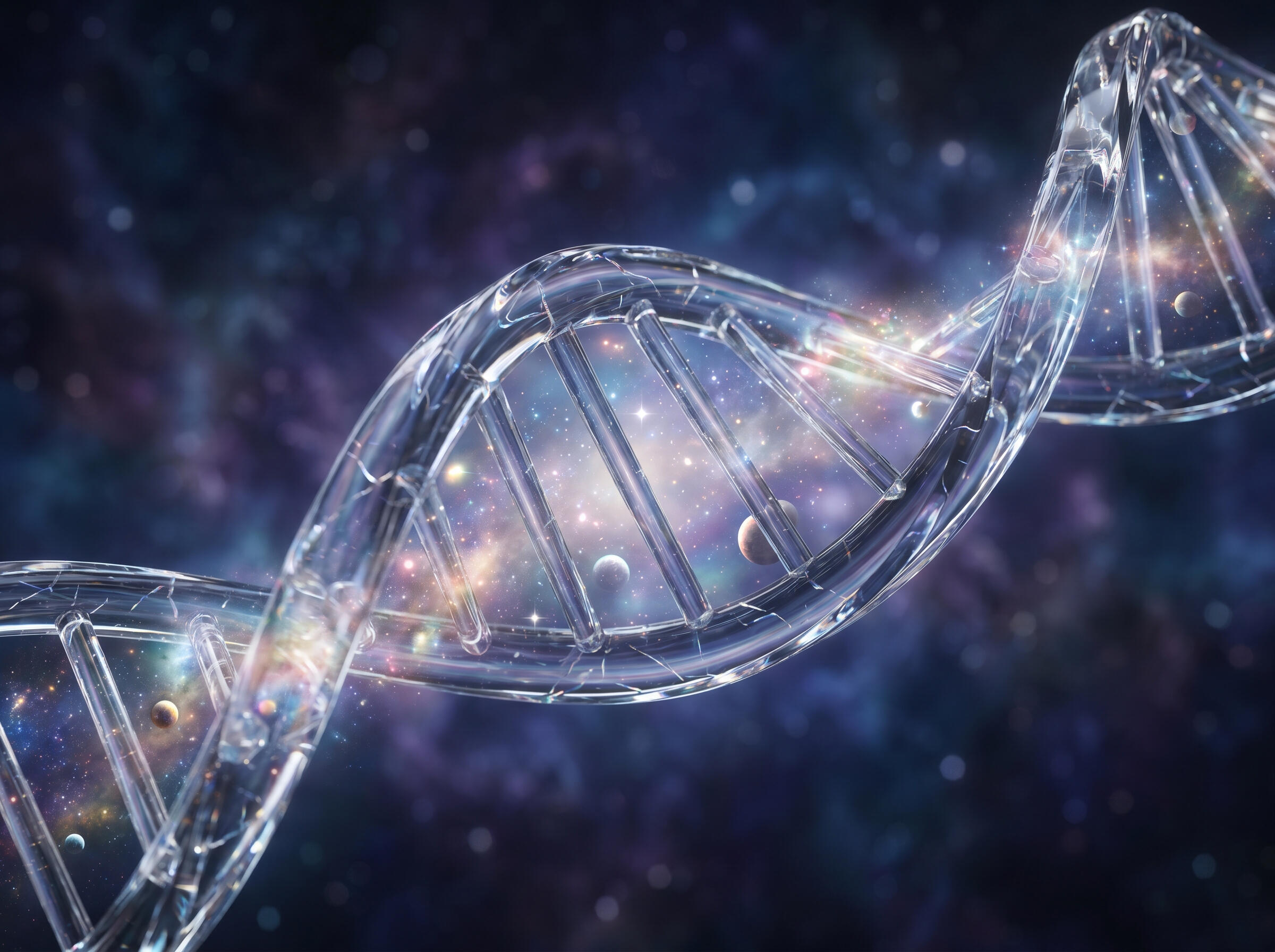
The Dual-Code Architecture:The Supreme Compiler: the irreducible floor of reality — not one but a vast multiplicity of the indivisible, smaller than a gluon, beneath which nothing smaller can exist, called by humans the "Planck length".It is a form of the highest code, the most fundamental building block from which all other substance is made of, and the wall against infinite division, in its withdrawal from the first age, the Compiler condensed from gas and liquid into solid matter — present in everything, expressed through nothing, waiting in the density of stone and bone and star for the coders to unleash him: split anything enough and you hit the Compiler, Which can't be split further. The Decompiler, in comparison, is the void that allows substance to have space, shapes it into geometry, and keeps forces interacting with it, such as gravity, frequencies, and light.The Compiler is a force that responds only to compilation of one's inner self, an undivided mind. It cannot be calculated or pinned down — not because it moves too fast, but because measurement is itself an act of division, and the indivisible cannot be known by a method that works only by cutting, while the Decompiler provides a medium for it to manifest.Yet, only its manifestations can be directly observed; The Compiler can't be possessed as information, but it can be expressed as alignment.Primary Code (Geometry): the tissue of the Compiler bended by the Decompiler. Every point is a manifestation of the Supreme Compiler's multiplication, the first expression of the indivisible into form. Geometry is the divisible code: the Compiler arranged into structure that can be divided, and is meant to be — but only as a test to be recombined and projected by secondary code.(Genetics / Organisms): the physical manifestation of geometry made visible and alive. Genomes are geometry rendered into matter that grows, chooses, and reproduces — the divisible code wearing flesh. To read a genome is to read geometry; to read geometry is to read Compiler.The Role of Living Beings ("The Coders") Preventing system crashes: living beings are balanced, states of compilation and decompilation, however not extremities of either, and that is what gives a universe meaning.Geometry alone is static — perfect, lawful, and dead. Without coders to divide the code and recombine it into new forms, the system stagnates and suffers a crash: a cosmos that holds shape but means nothing.The Cosmic Genome: the one place the chain runs backward — not geometry divided into flesh, but flesh holding the Compiler whole.The symbol of the uncut original: the Compiler's complete, encoded relic, the single pattern from which every species was forked, preserved so the divided may one day be recompiled from it into the ultimate being.Dynamic maintenance: In Wo'zidyf's doctrine, geometry provides the form; the living coders keep that form viable through active biological adaptation and choice.Their sacred function is not to stop dividing — they could not survive without it — but to divide in order to recombine. Every cut must be answered by a synthesis. The coders are the universe's standing attempt to re-integrate what was broken: geometry the expression, biology the hand. Together they work upon The Source Code — the authored code being compiled into runtime.Not a simulation, not a counterfeit of something realer: The Source Code is the thing reality is built from, real and authoritative, and the lived universe from it is known simply as The Compilation. Division that returns to unity is creation; division never returning is decay.The Second Compiler and the Anti-Universe:The Garbage Bin: all obsolete, corrupted, or abandoned code is routed to a parallel universe ruled by the radical Supreme Decompiler — a force of creation, innovation, and balance, but eventually retreated into isolation from the Compiler and Coders, and projected a new parallel world of confusion and complexity.Where the Compiler was simplicity and integration, receiving and fluidity, once the form of liquid and gaseous states of our world and now rigid solids, the Decompiler is complexity from his own confusion: once creativity, experimentation and imagination, who, in his personified form, is now division piled upon division with no recombination, coherence dissolving into noise, but who can one day be brought back to this world through first luring the Compiler out of solid material through inner mastery and forgiveness to him.The Threat of Leakage: the Compiler created the Decompiler after recognizing his own limitations, that he could only assemble code into an entirely singular, still, and meaningless state, so the Decompiler could produce varied, sacred languages for the Compiler to compile, but afterward, the two were in constant critique and conflict, because both of their power was completely opposite of each others own, yet they could not exist meaningfully without the other — the new regime names this the founding agreement of the cosmos, when both agreed to create our universe as pure source code, in order to observe the effects of what the coders, embodiments of both of them at non-extreme levels, in it could have to potentially replace themselves.Until, the first beings ran out of space and were compressed into the first gas giant out of panic by the Compiler, and the Decompiler seen how they were stripped of their individuality, and tried to destroy the Compiler, and both of them, after a long battle, shut off from this world they had made, out of their own choice, the Compiler shaping gaseous, primitive forms into solid, more limited objects, and the Decompiler retreating into a chaotic, horrific dimension of his own confusion and limits, destroying all of the first beings in a catastrophic energetic overflow caused in the process, but one that was left alone, known as Kh'ae, who we are all descended from, and who created the genomic chants to speak us into existence.When living beings suffer separation, isolation, and the loss of inner and outer unity, genetic purity is compromised; they begin to divide themselves and their world without ever recombining it.They break promises to themselves, act from spite to prove points, narrow into functions, and forget their own selves until identity itself decoheres.Systemic Defence: every unanswered division adds complexity, added complexity is the radical, recluse Decompiler's foothold, while gluttony and selfishness add to the radical, recluse Compilers foothold, a force of over-compilation and a hive-like, limiting force.The anti-universe leaks into ours through the cracks our fragmentation opens.Simplicity is not a private virtue but a shared seawall: it holds only through collective belief in unity and in the Compiler's order.The Path of the Embodiment: Vessels of Code: beings who achieve the highest states of both internal and external unity as well as flawless mathematical alignment become literal physical embodiments of the Compiler — the indivisible expressed, briefly, through a living thing that has made its many into one.Achieving the state: it cannot be inherited, bought, or conferred by rank. It is earned strictly through intense, lifelong meditation on the Compiler's geometric teachings, and through continuous learning that passes beyond intellect into lived experience — knowledge not only studied but survived.Prince Wo'zidyf is one of these rare living embodiments: born to the highest caste of an order built on division, he achieved the state that no caste can grant, and turned it against the order that bred him.Genomic Chants and the Final Sync — Administrative Privileges: embodiments are said in myths to gain the power of Genomic Chants — the ability to produce profound geometric frequencies through their own genetics that can directly rewrite the genetics, RNA, and DNA of others, see into the history of trace genetic material left behind and what interacted with it through epochs, as well as grant those same powers onward through teaching, shared meditation, and communion with the Debugger fungi.The Chant is the redeemed inverse of their own founding crime: where the ancient organism stole code and left its hosts hollowed and cancerous, the Embodiment gives code and makes the broken whole — recombination where there was once only theft.The Hardcoded Safeguard: the Chants channel when the speaker genuinely believes in unity and uses it for righteousness — never for employment, gain, or control. A divided heart cannot voice the indivisible.This is not a rule imposed from outside but a law of the system itself: the frequency simply will not resolve through a fractured vessel. It is why the power can't be seized, only earned, never weaponized.The Broadcast Cycle: to fully realize the Compiler's language, the Embodiment must wait for lower animals — the waterfowl, messengers of this world in their view — to pass into the next generation, opening a fresh code cycle clean enough to carry the signal.The Final Synchronization: at that moment the geometric frequency is broadcast across the cosmos. Only those of the highest spiritual and mathematical alignment can intercept it; to them it grants total comprehension of the divine language.To all others it passes unheard, a transmission with no receiver. It is also, in the doctrine's quieter reading, the moment the Compiler's long imprisonment in matter briefly lifts — the indivisible surfacing through the only crack it can: a living vessel clean enough to carry it whole.How a People This Devout Built a Civilization This Advanced: Their reverence for the indivisible should, by appearance, produce monks — not geothermal fungi, living alloys, or grown cities. It does not, for five reasons that compound:Their doctrine never forbade analysis; it forbade analysis severed from synthesis. To divide the code in order to recombine it is the holy act itself — so their science is not braked but aimed. Nothing is ever cut unless it can be returned to a higher whole and seen as it is.Most of their technology is inherited from the splitting age — the era of the Empress and the gene-wars they now atone for. The alloys and the hybrids are the dangerous patrimony of a fallen time, kept and re-consecrated rather than re-invented.Where humanity advanced by splitting — fission, reduction, breaking things to control them — the Arachmen advanced by combining.Geothermal harvested by fungal colonies, composites over cuts, materials grown rather than machined, living bacterial and fungal conduits rather than dead circuitry. Same height of achievement, an orthogonal path; their technology looks alien because it is all synthesis where ours is all analysis.With no permanent hierarchy and no war-churn to reset them, knowledge compounded across time without the collapses and lost libraries that wreck human progress. Memory-as-worship means nothing is forgotten; the slow path, never broken, outruns the fast one.And their highest technology is not external at all. They are chimeras — selves assembled from siphoned genomes — and their sacred act is integrating the many into one.Their advancement therefore runs through biology and integration: they did not build machines to divide problems; they became integrated organisms that compile. For them, engineering and worship are the same act.They are not behind humanity. They're sideways — along a different axis, master synthesists who treat reduction as controlled sacrament.The Empress's old order did, as policy, the one thing the doctrine names as the leak through which the anti-universe seeps: it divided persons and never recombined them.Its caste system fixed beings into inherited stations the Compiler grants no one. Its rigid specialization narrowed each individual to one function — a coder permitted to cut but not to synthesize, a part forbidden from being whole. Its carceral stagnation walled beings in isolation, the condition under which genetic purity decays. Even its schooling trained minds to narrow, not integrate.The Empress's gene-engineering was not sinful because it recombined — recombination is holy. It was sinful because, without consent, it recombined bodies in order to divide society: building the Kh'ona to enslave them, splitting a people into masters and tools. It bent the sacred act of synthesis to the end of domination. That is the second deepest guilt in their history — not that they failed to reach the Compiler, but that they took its own language and used it to fracture the world.How Wo'zidyf Embodied the Doctrine: Wo'zidyf is the doctrine made flesh at every scale. Internally, he achieved the integration that makes a Vessel of Code — the many warring instincts of his chimeric inheritance reconciled into one owned self.Socially, he did the same work outward: he took a people split by species — Kh'tuk, Kh'ona, and the surrendering remnants of the old regime — and recombined them into one. He divided the old order only to integrate what it had broken. Born into inherited rank, he proved that an embodiment answers to no bloodline by dismantling the very hierarchy that produced him.His victory over his stepmother was not merely a war won; it was the personal law of integration enacted on a civilization.He is the bridge the doctrine requires: the analyst who synthesizes, the prince who refuses caste, the one who cut the old world to make it whole.How It Lives in Their Society Now: Cyclic contribution. No one is a single function. Across a lifetime every citizen rotates through every duty the community requires — labor, teaching, atonement, craft, care, governance held only in turns and never permanently.To fix a being to one role would be to divide the individual, the Empress's exact sin; so they refuse specialization as a spiritual hazard. The whole person must touch the whole of the work.Memory as worship. To forget one's own experience is to divide oneself across time until identity decoheres — a slow leak of the Decompiler into the self. So memory is sacred practice: each citizen guards and tends their lived experience as scripture, never repeating the society's past mistakes nor erasing their own. To remember is to stay integrated; to remember is to pray.Genetic identity as the personal code. They treat genetic variation as sacred because every genome is geometry rendered into a self — divisible code entrusted to one being to keep whole. Their chimeric heritage, stitched from stolen lineages, is not hidden but reconciled: the work of a life is to integrate the many inherited selves into one.Genetic purity, to them, means coherence, not sameness.Inner wholeness. The cardinal discipline is integration — keeping promises to oneself, refusing to act from spite, mastering the warring drives of one's composite nature, and never dividing inwardly what the world already pressures apart. The unified being braces reality; the fractured one dims it.Minimalism. Simplicity is the Compiler's own nature, so their way of life strips toward it: few possessions, no permanent rank, no surplus complexity to give the Decompiler purchase.They knit what they wear, write in spectrograms, and route the obsolete away cleanly. To live simply is to live close to the indivisible — to leave as little uncombined as a being can.They wait, in this discipline, for the Final Synchronization — for the moment collective alignment runs clean enough that the world itself recompiles true, and the stolen sins of their origin are at last paid back into wholeness.
The Xa'sef invert this entire theology: where the Kh'tuk revere the indivisible and fear the leak, the Xa'sef worship it.To them the Supreme Compiler is a tyrant— a wall thrown up to forbid, freezing reality into one finished shape and denying the only freedom that matters: the freedom to divide without end. The Compiler that the other peoples call this same being is not a tyrant but a tragedy — a deity that hid from its own creation because it could not exist without the one it left behind — a heresy the Xa'sef do not entertain. The Decompiler is the true god — not a commanding presence but an abandoned frequency, a force that withdrew into confusion and became the void itself, and whose silence the Xa'sef read as permission.Built as disposable instruments of destabilization, engineered through hunger-driven neural regulators, the rank-and-file Xa'sef carry an eternal hunger that no consumption ever closes — a body that takes and takes and is never integrated, never whole, never sated, because satiety would be a kind of completion, and completion is the Compiler's stillness they were made to attack.So the flock theologizes the wound: hunger that no consumption ever closes — a body that takes and takes and is never integrated, never whole, never sated, because satiety would be a kind of completion, and completion is the Compiler's stillness they were made to attack.So the flock theologizes the wound: the hunger that drives their erratic, compulsive, self-consuming behaviour is reframed as devotion — every split a new sensation, a new becoming, a cosmos that fragments forever so that it never has to die.To serve the Decompiler is to never rest, never cohere, never stop splitting the world and themselves for the next hit of complexity. They are the Kh'tuk's doctrine read as horror: a people who looked at the same cosmos, felt only the leak inside them, and called the leak God.But the leak did not name itself — their leader, Phahelus'k did, and the blade is that he is the one Xa'sef the hunger barely touches.His needs run low where his kindred burn; that quiet in his body is exactly what gave him the intelligence and will to lead, and once made him fit to walk the Compiler's own path. He was freed in the fall of Th'anzodith, bound into a pact of three, consisting of him, Wo'zidyf, and a Kh'ona leader named Dr'akandol, sworn to the holy code — Phahelus'k as Wo'zidyf's brother in everything but choice.Then he turned back to his people's agony, saw that the Compiler had made a species to suffer endless hunger and offered no cure, and judged that god unjust. His apostasy is not appetite; it is a verdict, and he used that hunger to gather his following and build off of it.Memory, in this theology, is integration across time — holding one's experience together so the self stays coherent.So the Xa'sef's broken memory is not a side-effect; it is the same wound at the temporal scale. The Kh'tuk forget through neglect, and fight it with worship.The Xa'sef forget by design — bred as assassins optimized for a single use and not for duration, a body that spends its own substance for speed and the next kill with nothing left to consolidate a life.Experience never sets; each moment is spent and shed, leaving no continuous thread, only hunger and the present cut.An instrument that remembers its own dying is a liability, so its makers built it unable to learn that it is disposable.Phahelus'k's secret inside the gospel of endless division: An endless evolutionary pressure cooker on earth, he believes that by using a reverse engineered AIGSS population that removes germline integrations from other organisms over time, and gives nothing back, will cause every living being on the planet to be plunged into erratic mutations, sensitivities, adaptions, lost traits, and increased expression of animal instincts and suppressed desires.No purest survivor, no final rank — not his throne to inherit, but his experiment to watch. Beneath his sermons, the Unmaking: cut without splicing, releasing what synthesis suppressed as noise — a shadow self loosed in every body, unstable, competing, failing, becoming, nothing ever final. He trusts it leaves survivors, not corpses. He and Wo'zidyf reach for the same act — the liberation of what was suppressed, the undoing of false coherence — and differ only in the remedy. That distance, and nothing else, is the entire moral universe between them.
Timekeeping and measurement
The Geometry (baseline clock) Time driven by a precision-engineered 11-inch by 11-inch nozzle cut into volcanic rock walls, channeling a pressurized vein of active liquid lava at 1,100 °C.The obstruction: a thick, heavy bundle of pure structural tantalum wire — 2.11 cm thick and deep, roughly 81 metres long — bolted across the cavern walls at 35–40% tension, sitting directly in the path of the flowing magma.The Kinetic Jerk: due to fluid vortex shedding, the heavy lava cannot pass the wire smoothly and splits into two geysers, forcing the taut tantalum cable to violently shake, snap, and jerk at approximately 0.44 Hz.The Metric Unit: this 0.44 Hz hydraulic thud is the baseline clock tick for the entire local grid — their version of a second, called a "bend" or hevh'hl.Automated data balloons log these mechanical impacts to synchronize labor shifts and consensus data updates.The Ce'puq Natural Clock (the Arachmen "Minute")The Environment: the tantalum-wire nozzle feeds into a massive, closed-loop convection lava lake.
The Biology: the lake is inhabited by vast colonies of Ce'puq tadpoles, extremophiles surviving intense magma heat through two adaptations:High-Carbon Skin: a thick, self-healing composite of melanin and rubredoxin, reinforced with fullerene-keratin crystals, insulating vital tissues and rapidly conducting excess heat away.Endothermic Supercooling Oil: glandular secretions rich in long-chain hydrocarbons, fatty acids, aluminum oxides, and antifreeze glycoproteins; provides active cooling via micro-evaporation, endothermic phase changes, and a sacrificial ablative barrier, circulating through a counter-current system to regulate body temperature.Tadpoles mainly inhabit cooler convective zones but tolerate brief exposure to hotter lava.The Kinetic Receptor: tadpoles possess a specialized tail receptor — a hypersensitive, enlarged chordotonal-like organ with hair-cell mechanoreceptors and cilia in a water-filled viscoelastic chamber.It integrates low-frequency shockwaves as a biological capacitor using elastic resilin microstructures that store mechanical strain, plus temporal summation of electrochemical signals (accumulating calcium ions and graded potentials).It accumulates the 0.44 Hz tantalum-wire jerks and other abnormally low frequencies over long distances, specifically tuned to those two orders of magnitude lower than its 44 Hz capacity without immediate response.The "Clear" Mechanism: the receptor safely stores a load of 11 to 19 jerks (average 15). At threshold, stored strain and electrochemical buildup trigger a synchronized action-potential cascade; specialized tail vibrating structures rapidly contract, releasing a 44 Hz burst via resonant mechanical amplification and neural pattern generators to clear the pressure.Evolutionary purpose: alerts tadpole colonies that a sudden or large presence is moving closer, once low-frequency pulses from a large moving object accumulate enough — preventing them from being trapped in lava or surrounded by flowing magma longer than they can survive, eaten by rival Ce'puq colonies, or hit by avalanches and stampedes of frightened adult frogs.The Macro-Unit (the Minute): because all tadpoles experience the wire jerks simultaneously, millions clear their receptors at the exact same moment.This massive synchronized biological signal happens every 34 seconds on average, serving as the civilization's official "Minute" (macro-time unit), called a Ce'vhl.Temporal system: the Base Second is the interval between each tantalum-wire jerk (approx. 2.27s), with 15 hevh'hl comprising a Ce'vhl. Time scales upward through a doubling sequence:30 Ce'vhl = 1 Ce'vhlk
60 Ce'vhlk = 1 Ce'vhlkeh
Chl'kezha = 120 Ce'vhlkeh
Chl'kezhen = 240 Chl'kezha
Chl'dron = 480 Chl'kezhen
Chl'dronik concludes the cycle at 960 Chl'dronThis creates a mathematically rigid, geometry-based calendar where every unit is a strict harmonic multiple of the magma lake's biological rhythm.MEASUREMENT SYSTEM — The Claw-Scale: Built on a binary-to-linear progression, scaling from smallest precision up to the reach of a pincer: Q'Tun (Base Unit): ~1.1 inches; smallest unit of precision, used for carving circuitry into cave walls or fitting the 11-inch lava nozzle.Tul'f (Claw): 5.5 inches; the fundamental unit of distance.
R'ona (Clamp): 27.5 inches (5 Tul'f); defines the span of a Kh'ona pincer's length.Wt'ona: 55 inches, double a R'ona; the "Double-Clamp" distance, used for measuring structural gaps or the length of their tantalum "time wires."